
The rise of Cyber Scam: How Scammers Manipulate
you
These days, the internet is a part of our life, and everyone is connected to one another through various channels. We may exchange items, talk on the phone, meet new people, etc. As technology advances, people are abusing it by participating in online frauds and it’s not always advisable to believe everything we see online.
According to SysGen (https://sysgen.ca/five-facts-internet/ )
- The Internet Hit 5.1 Billion Users in 2023.
- 60% Of Internet Use Is Mobile.
- More Than 50% Of Internet Users Make E-commerce Purchases Weekly.
Let us understand the term “CyberScam”
Cyber-Scam
A cyber scam, also known as online fraud, is a kind of criminal activity in which a perpetrator utilizes the internet to coerce or deceive a victim into disclosing personal or financial information.
The ultimate objective of a cyber scam is financial gain, which can be attained by means of phony social media profiles, websites, or emails.
There are many types of cyber scams that exist today which includes:
Types of Cyber-Scams
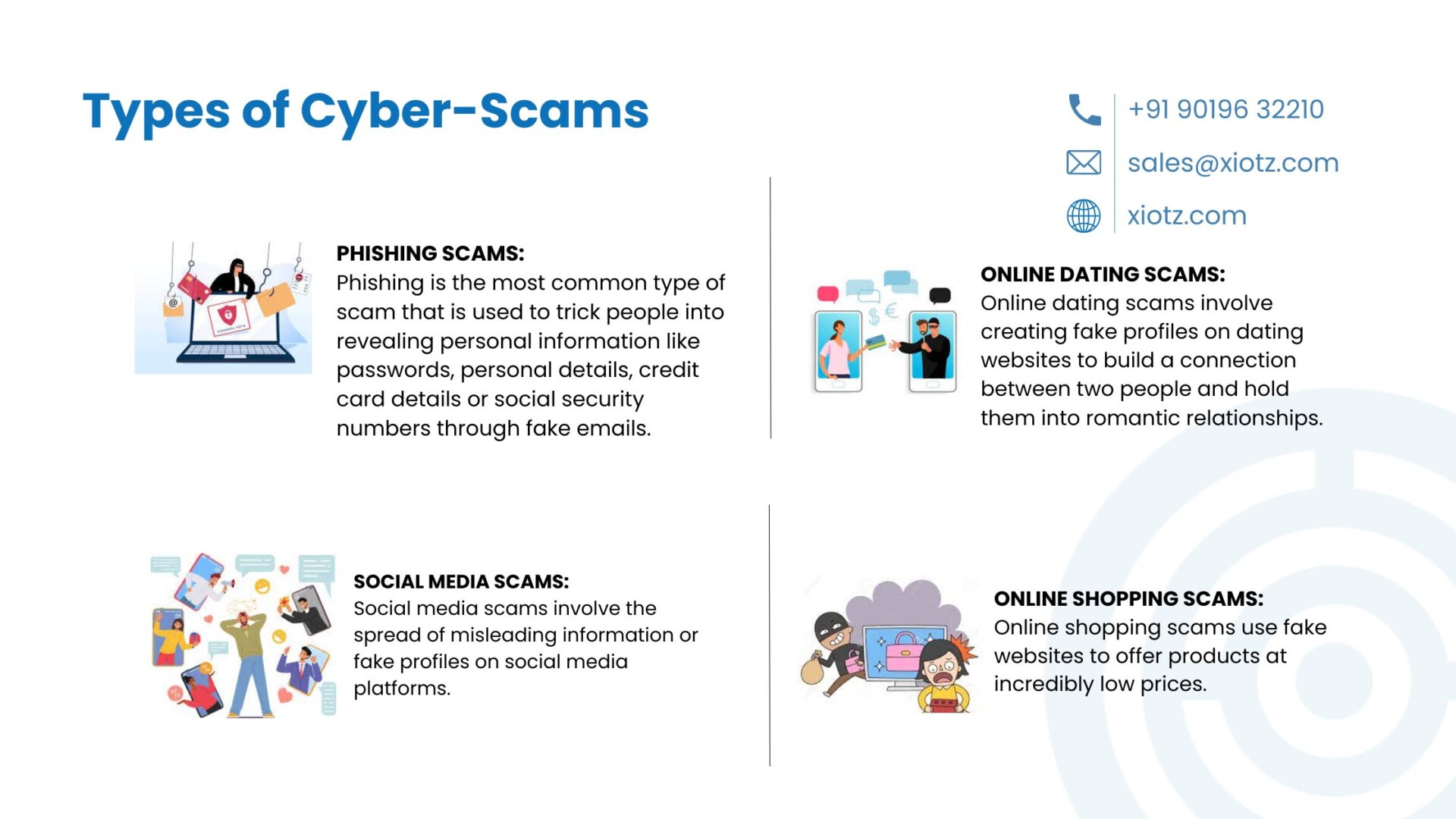
Phishing scams
The most prevalent fraud is phishing, which uses phony emails to deceive victims into disclosing personal information such as passwords, credit card numbers, or social security numbers. These emails appear to be from reputable or well-known websites, businesses, banks, or government organizations.
Such emails are written in persuasive language that make people believe in them.
It is estimated that 3.4 billion spam emails are sent every day.
Phishing assaults cost victims $136 in 2021, while cybercriminals took $44.2 million in stolen funds.
83% of emails were phishing in UK business in 2022.
Job offer scams
In Job offer scams, criminals promise attractive positions with high salaries and flexible work opportunities. Basically, the scammers ask for an upfront fee for job placement or training but never give a job and the job seekers are left with financial losses and disappointment.
In New Delhi, about 56%of job seekers in India face job offer scams.
Lottery scam
Criminals use job offer scams to lure victims in by promising flexible work schedules and enticing employment with big compensation. In essence, the con artists demand an advance payment for training or job placement but never provide employment, leaving the job searchers with disappointment and financial losses.
Victims have reported the highest average financial loss through lottery scams in 2022 which costs nearly $14.8K per victim.
Advance-fee scam
Advance-fee scams is a scam where the scammer will promise a high value goods, loans, prizes, etc in exchange for a small upfront fee. This money is taken from user and the promise is never fulfilled.
According to the UK statistics authority, the recorded cases of advance fee fraud increased from 60,000 to 454,000.
Online dating scams
Online dating scams involve creating fake profiles on dating websites to build a connection between two people and hold them into romantic relationships. Once trust is established, the scammers request money or personal information under various texts which leads to financial and emotional loss of a person.
In 2022, nearly 70,000 people reported a romance scam and reported losses hit a staggering $1.3 billion.
COVID-19 online scams
Due to COVID-19 pandemic, scammers have exploited the situation to create various scams which includes selling fake vaccines or treatments, phishing emails related to the virus or charity requests.
In 2020, the Federal Trade Commission (FTC) had logged more than 732,000 consumer complaints related to COVID-19 and stimulus payments since the start of the pandemic, 72.5 percent of them involving fraud or identity theft. These scams have cost consumers $778 million, with a median loss of $415.
Social media scams
Social media scams involve the spread of misleading information or fake profiles on social media platforms and scammers use these platforms to trick users for money for urgent help or use as identity theft.
Reports show that in the first six months of 2023, money lost through social media by people of age 20-29 was more than 38% and people of age 18-19 was 47%.
Online shopping scams
Online shopping scams use fake websites to offer products at incredibly low prices and after making a purchase, victims either receive low-quality goods or nothing at all.
Statistics reported a $48 billion loss from online payment fraud worldwide by 2023.
8 Things your Should never share Online

- Social security number (SSN)
- Bank account number (BAN)
- Phone Number
- One-Time Password (OTP)
- Birth Date
- Password
- Area Code and
- Sensitive information.
6 Things you need to be careful about

- Things that are “too good to be true”
- Romance Scammer
- Fake Profiles
- Online Offers and Scams
- Fake URL and Websites
- Deep Fake.
How to protect yourself from these scams
- Stay informed about the latest scams and cybersecurity threats.
- Create strong, unique passwords for online accounts.
- Enable Two-Factor Authentication (2FA) whenever possible.
- Be cautious with emails and messages from unknown senders.
- Avoid opening suspicious emails or messages.
- Exercise caution with unsolicited attachments and links in emails or messages.
- Verify the sender’s authenticity and use official channels if in doubt.
- Check website URLs for accuracy and security (look for “https://” and padlock symbol).
- Type website URLs directly into your browser instead of clicking on links in emails.
- Keep your operating system, software, and antivirus programs up to date.
- Protect your personal information, avoid sharing sensitive information such as bank account number over email or phone calls.
- Independently verify the authenticity of companies or government agencies contacting you.
- Be skeptical of offers that seem too good to be true.
- When forming interactions online, use caution and never give out your personal information or money to strangers.
- Verify the identity of online contacts if you suspect fraud.
- Research charities before donating online to ensure their legitimacy.
- Safeguard financial information and never share sensitive details with unverified individuals or on unsecured websites.
- Stay informed about current scams through news sources and cybersecurity blogs.
- Report suspicious activity to appropriate authorities or organizations.
- Install reputable antivirus and antimalware software on your devices.
Conclusion
The internet has become a big part of our lives which connect us around the world, but along with it, risks are also increasing like cyber scams that can trick us into financial or reputational loss.
By staying informed about the latest scams and following the necessary measures, we can protect ourselves from these kinds of scams. Everything that appears online is not true, so Stay safe and be careful when you’re on the internet!
Related Blogs:
Cyber Safety : Protect your Online Identify
Guarding your digital world with digital aid
Cyber safety in the age of social media
Related Terms:
References:
What is Cyber Fraud? | Mimecast
Cyber Security: Spam, Scams, Frauds and Identity Theft
Quick Links: