

Introduction
Indian regulators sent businesses a loud and clear warning:
If you ignore compliance, you will pay the price.
Enforcement has increased, and penalties are now stricter under India’s cyber security and data protection laws.
Organizations of all sizes—including established enterprises—now operate under sustained close review and higher expectations around compliance management.
The outcome is straightforward: organizations can no longer treat cyber security compliance as a secondary concern.
Cyber Security today isn’t just about installing firewalls, blocking viruses, or reacting when hackers attack.
Regulators now expect organizations to show accountability through strong data controls, continuous threat monitoring, and clear documentation.
Despite this shift, the reality remains clear: most enterprises are still unprepared.
Many organizations still rely on outdated operating models.
They wait until deadlines are close, rush during audits, and address compliance gaps only after regulators intervene.
This leaves them vulnerable on two fronts:
- Hackers → who attack when defenses are weak.
- Regulators → who punish when compliance fails.
The consequences are clear: heavy fines, loss of customer trust, and lasting damage to the brand that can take years to fix.
Cyber Compliance in India
India’s regulations are now stricter and follow global data protection and security standards.
Organizations must now comply with multiple mandates, each governing different aspects of business operations and data security:
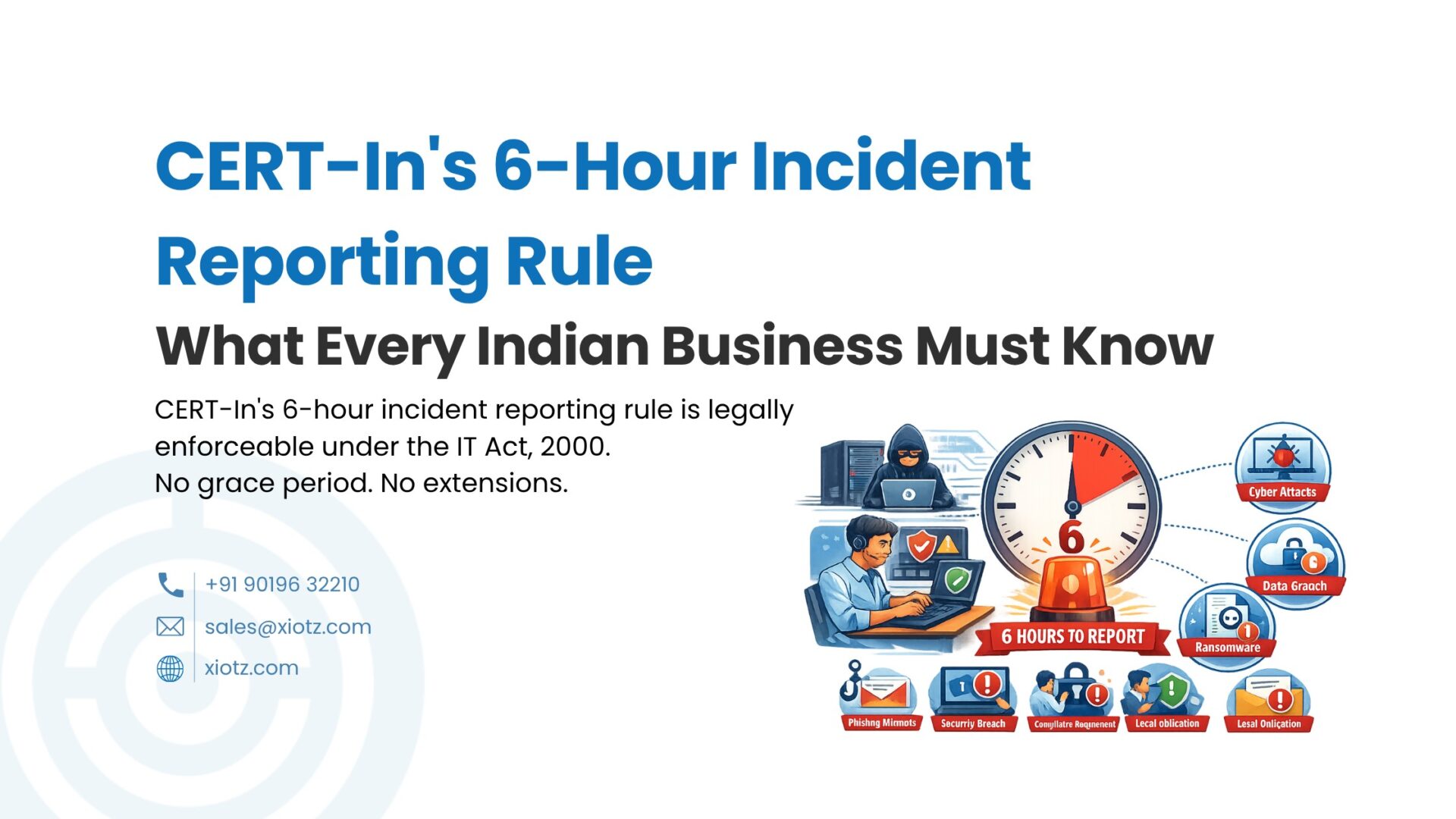
- CERT-In directives – Organizations must report cyber security incidents within strict timelines.
- SEBI cyber security requirements – Financial institutions must show ongoing cyber preparedness, not periodic checks.
- DPDP Act – India’s data protection law that holds organizations accountable for how personal data is handled.
- RBI cyber security compliance framework – Banks and payment systems must protect their environments from evolving threats.
- ISO 27001 and NIST – Global standards that define best practices for securing systems and payment data.

For large enterprises, these requirements are complex.
It causes serious difficulties for smaller companies.
Regardless of size, one principle now applies universally:
Non-compliance is no longer allowed under current regulations.
Why Traditional Approaches to Compliance Fail?
Many organizations continue to treat compliance as a periodic exercise rather than an ongoing discipline:
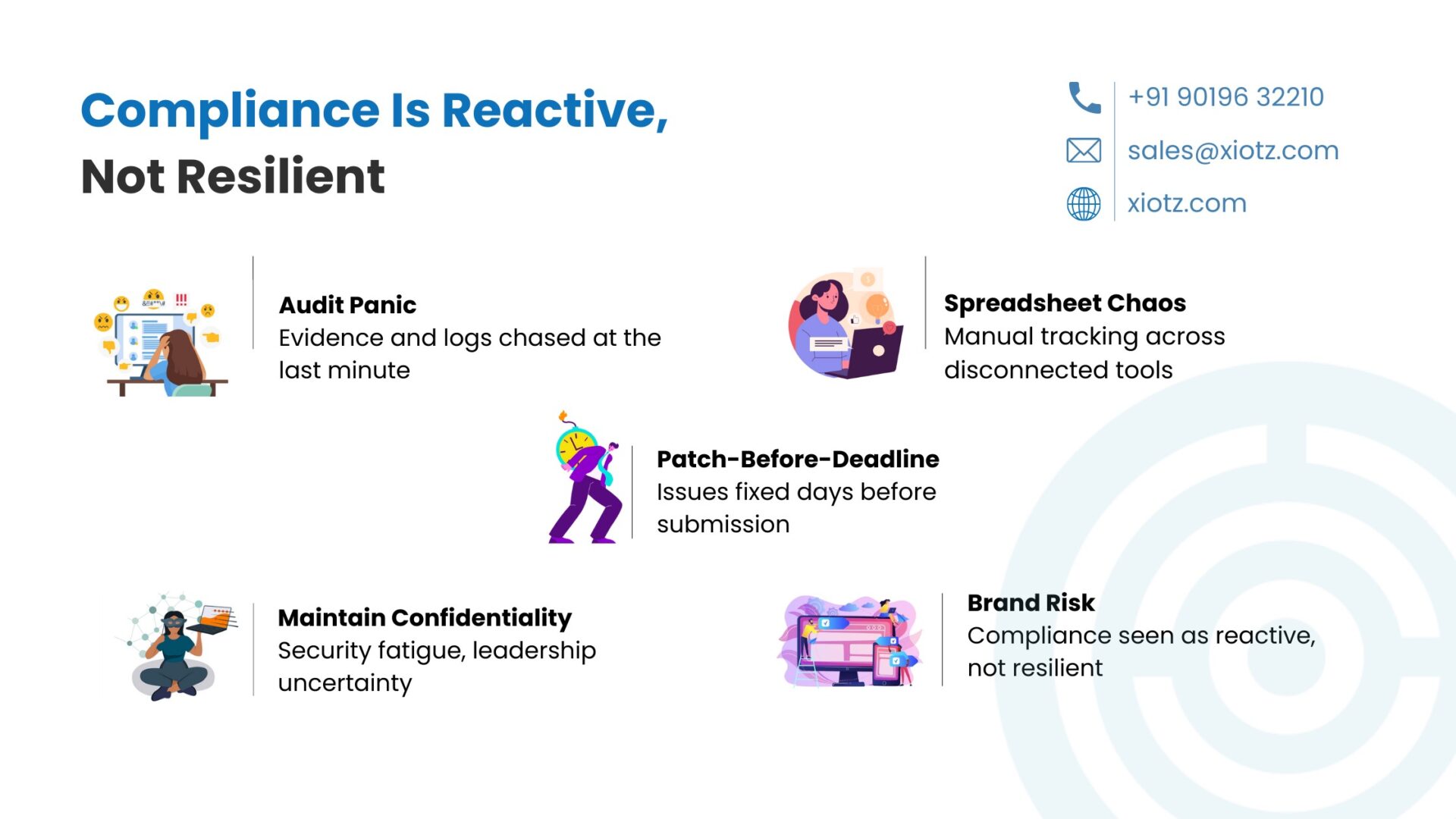
Audit-driven panic cycles
Compliance efforts increase only when the organization announces the audit. Teams rush to collect evidence, validate controls, and patch gaps—often under extreme pressure.
- No continuous visibility into compliance status
- Decisions driven by urgency, not risk
- Same issues resurface in every audit cycle
- Instead of strengthening security posture, audits become a fire-drill.
Manual spreadsheets for compliance tracking
Spreadsheets remain the backbone of compliance for many organizations—despite being error-prone and unscalable.
- No real-time updates or control validation
- Version conflicts and inconsistent data
- High dependency on individuals rather than systems
This creates blind spots, especially as environments scale across cloud, endpoints, and third-party systems.
Last-minute corrections
Controls are “fixed” just enough to pass the audit—without addressing root causes.
- Temporary compensating controls
- Short-term documentation fixes
- Security debt silently accumulates
Once the audit ends, so does the urgency—until the next cycle begins.
Burnout across IT and security teams
Compliance becomes an added burden rather than a built-in capability.
- Repetitive evidence collection
- Manual reporting across frameworks
- Constant context switching during audits
Over time, teams spend more energy proving security than improving security—leading to fatigue and disengagement.
Reactive compliance postures
Traditional compliance models respond only after auditors, regulators, or attackers identify risks.
- No early warning signals
- Limited correlation between controls and real threats
- Compliance and security operate in silos
This reactive stance leaves organizations exposed between audit windows.
These reactive practices consume time, increase costs, and weaken organizational morale.
More critically, they leave gaps between audits—periods when security posture degrades and risks remain unmanaged.
Treating compliance as a short-term project creates fluctuations in both control effectiveness and incident preparedness
Cyber threats are always active, and regulators now monitor compliance all the time.
A Shift in Mindset: Building a Continuous Compliance Framework
The more effective approach is structural, not episodic.
Organizations often fail compliance requirements because compliance is not part of daily security operations.
When compliance lives outside the security fabric, it surfaces only during audits, creating friction, rework, and risk.
At xIoTz, we do not treat compliance as an afterthought or an external obligation.
This means compliance is no longer something teams prepare for—it’s something they operate with, every day.
Rather than reacting to audits, organizations integrate compliance into daily workflows through:
- Automated monitoring follow CERT-In, SEBI, RBI, DPDP, ISO 27001 and other security standards.
- Real-time gap assessment that delivers proactive, actionable, risk-mitigating insights for audit readiness.
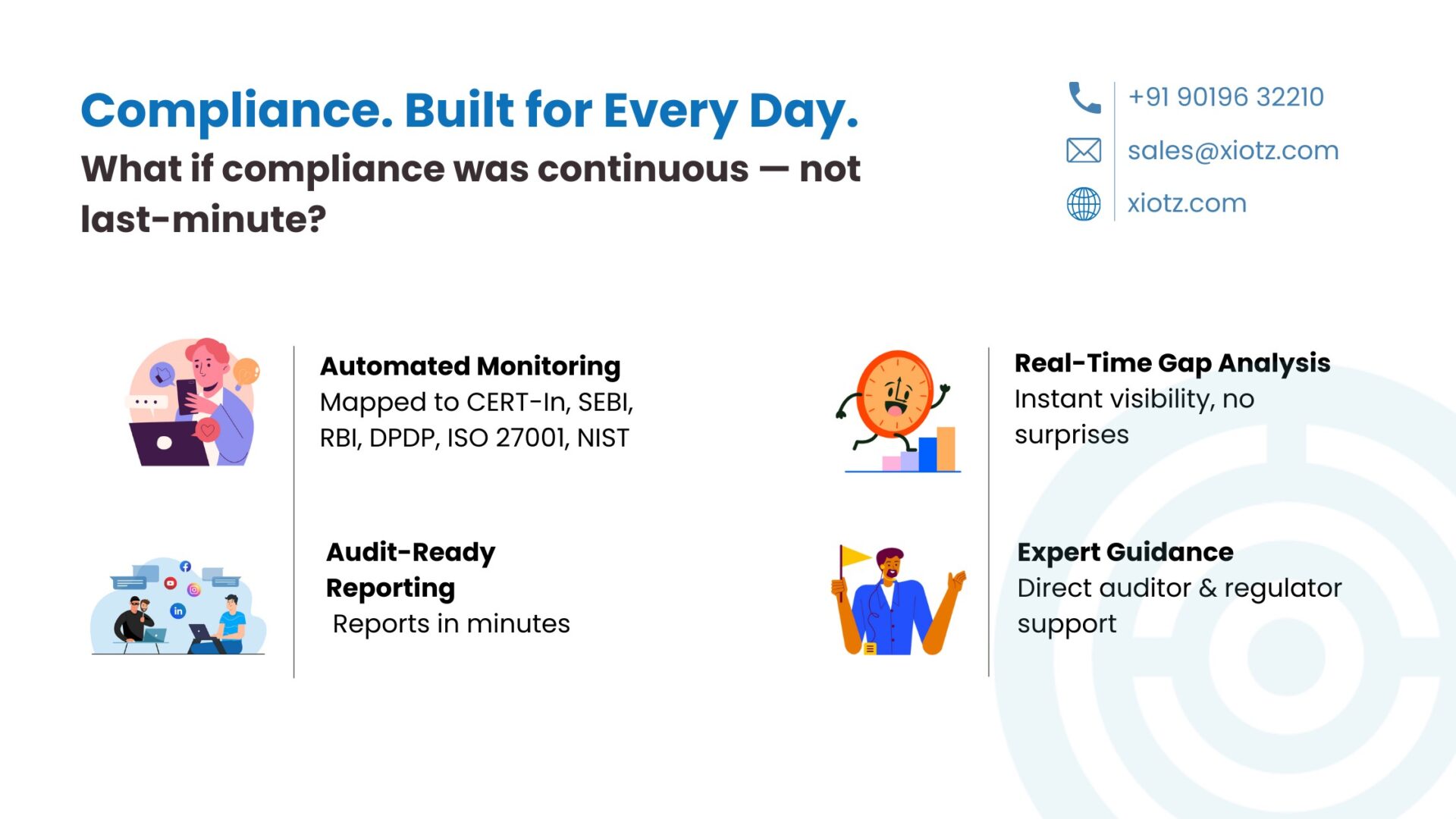
- Audit-ready reporting designed to support regulators and auditors efficiently.
- Expert-led engagement supporting discussions with regulators on controls, evidence, and accountability
This approach enables continuous compliance management instead of episodic fixes.
Case in Point: From Scramble to Strength After a Security Breach
A mid-sized financial firm we partnered with illustrates this shift clearly.
Before UCAP:
- A biannual, organization-wide compliance effort .
- Audit preparation viewed as more disruptive than security incidents
- Repeated delays and financial penalties
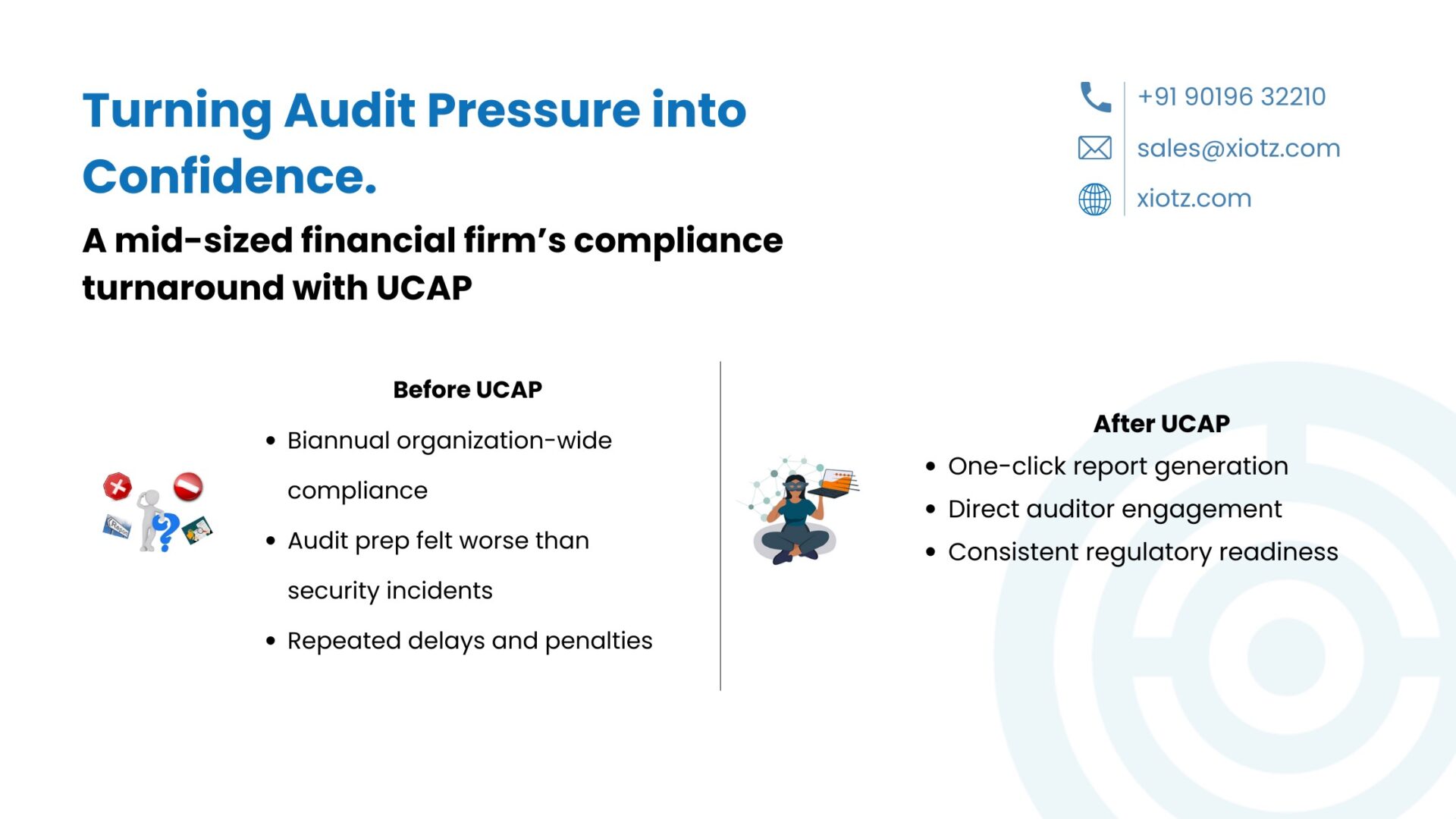
After UCAP:
- Reports generated with a single action.
- Direct expert engagement with auditors.
- Consistent readiness across regulatory reviews
The transition delivered measurable business stability. Compliance evolved from a pressure point into a confidence mechanism.
Compliance as a Competitive Advantage
Effective compliance is not limited to avoiding penalties. When executed well, it becomes a competitive advantage.
- Investors perceive reduced operational risk and long-term preparedness
- Customers place confidence in responsible data handling
- Regulators recognize structured compliance engagement
- Boards reinforce accountability across business operations
In a regulated digital environment, leadership is defined by innovation supported by proactive and transparent compliance.
Stay Ahead, Not Behind!
Cyber security compliance in India depends on several rules and guideline.
These include CERT-In directives, SEBI rules, RBI guidelines, and the DPDP Act requirements. It also needs to meet global standards like GDPR, HIPAA, and PCI DSS.
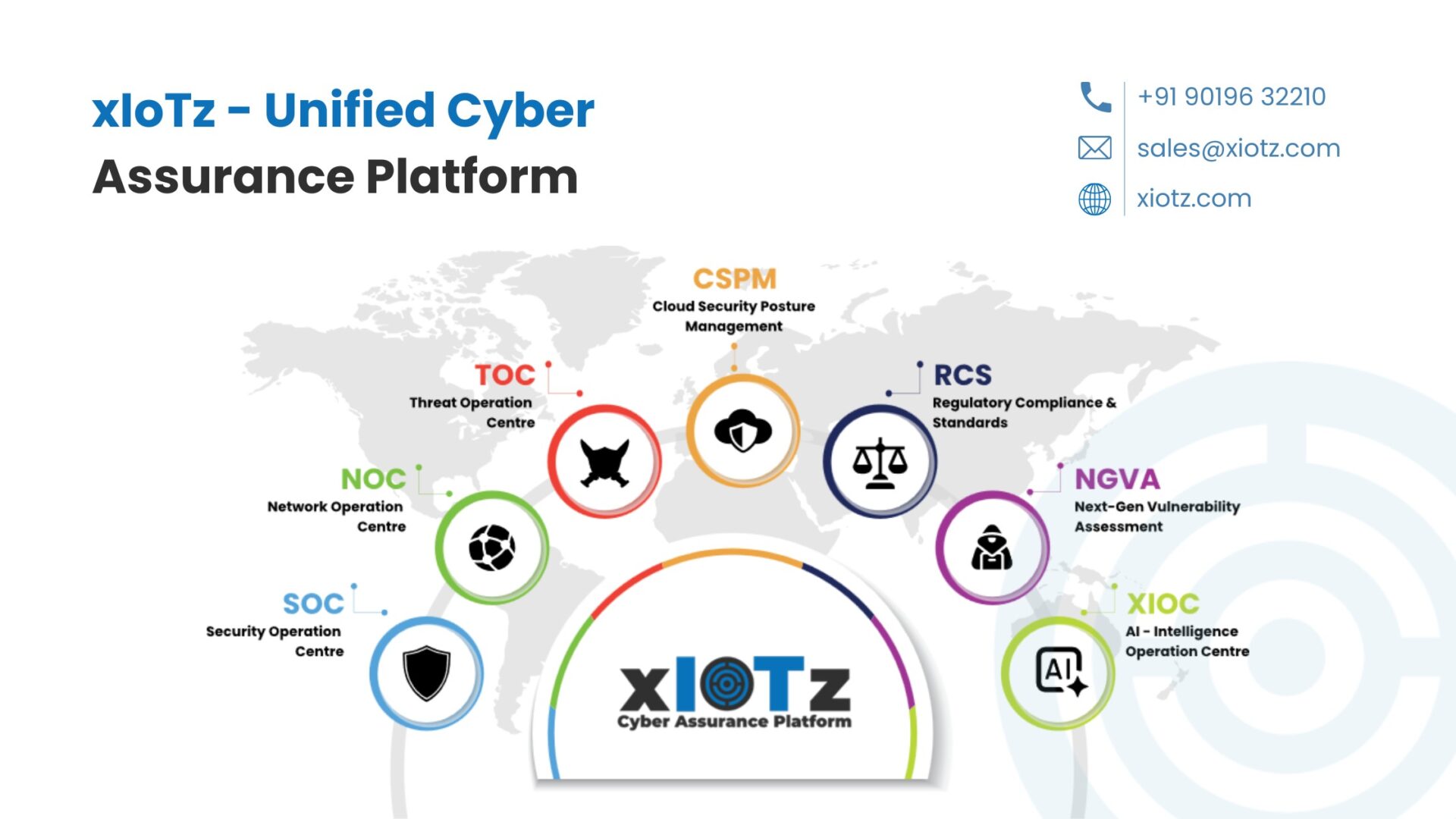
Leading organizations are adopting platforms that make compliance continuous, visible, and provable. UCAP helps that shift—supporting security, regulatory readiness, and organizational confidence without disruption.
- Awareness
- Celebrations
- Education
- Event
- Experience
- Newsroom
- Opportunities
- Uncategorized
- Web Stories
- xIoTz Features
April 8, 2026/
xIoTz helped shape India's CERT-In compliance framework. Here's the practitioner's checklist — all 15 controls, the penalties most businesses don't know about, and how to...

March 27, 2026/
India's 63 million MSMEs finally have a cybersecurity baseline. xIoTz has contributed to the National Cybersecurity Framework for MSMEs — specifically the 15 Elemental Cyber...

March 27, 2026/
xIoTz Private Limited has been named the winner of a national defence innovation challenge for developing an indigenous Security Information and Event Management (SIEM) solution...

Security
Operation
Centre
SOC

Network
Operation
Centre
NOC
Threat
Operation
Centre
TOC

Cloud
Security Posture
Management
CSPM

Regulatory
Compliance
& Standards
RCS

Next-Gen
Vulnerability
Management
NGVM

AI-Intelligence
Operation
Center
XIOC